History
From America to Southern Europe and then worldwide
Sunflower is a globally renowned agricultural crop, primarily
cultivated for its oil-rich seeds. Historical records indicate that
sunflowers were grown by Native Americans as far back as 5,000 years ago. In
the early 16th century, thanks to the Spanish explorer Monardes, the seeds of
these plants reached Southern Europe, and from there, they spread worldwide.
Oil extracted from the seeds of this plant has been highly popular for many
years. It has earned its widespread use primarily for its delicate
flavour and high stability. Naturally present phytonutrients and
essential fatty acids undoubtedly add to its value. Thanks to all its benefits,
sunflower ranks among the most important cultivated oilseeds in the
world.
Origin and Cultivation
You certainly won't miss a sunflower due to its size
and colour
The common sunflower is a plant you definitely won't miss due to its robust
growth and bright yellow petals. Most of the time, its flowers face upwards and
turn towards the sun. Later, at the stage of full maturity, the flower heads
become heavy and bow towards the ground. These mature sunflower seeds,
concentrated in the centres of the flowers, are de-hulled and pressed
into the resulting sunflower oil.
Composition and Properties
Yellow colour and characteristically delicate flavour. BUT
ODOURLESS
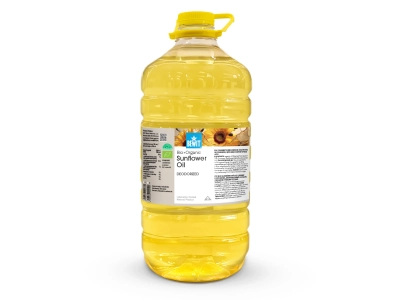
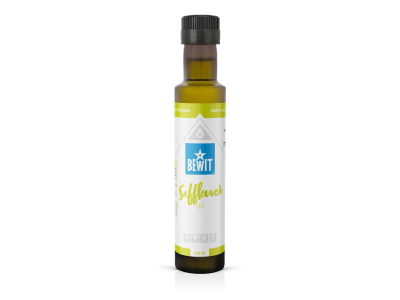
This single-variety, organic-certified sunflower oil has a light to dark
yellow colour and a characteristically delicate flavour.
Sunflower oil is obtained by gentle cold-pressing and then subjected
to deodorisation. This gives it a neutral aroma = the oil is odourless.
The aforementioned processes are carried out gently, preserving the maximum
amount of vitamins, minerals, and beneficial substances in the resulting oil.
The high content of the well-known antioxidant – fat-soluble
Tocopherol – is also significant.
Sunflower oil predominantly contains unsaturated fatty acids, which
make up to 93% of the total composition.
Production Method
Cold-pressed, deodorised – oil obtained from seeds or
fruits at a temperature not exceeding 40°C. Suitable for cold cuisine.
Usage
Sunflower oil is a staple in your household
Due to its high stability, sunflower oil can be used not only in cold but
also in hot cuisine. It is suitable for cooking, baking, and
frying. Thanks to its delicate flavour and neutral
aroma, it is suitable for both savoury and sweet dishes.
Benefits
- 100% natural, organic quality
- Gentle processing method (maximum amount of vitamins, minerals,
antioxidants, and other beneficial substances preserved)
- „Oil with a high oleic acid content“ (due to the presence of
monounsaturated fatty acids) – much higher thermo-oxidative stability
COUNTRY OF ORIGIN
Slovakia
Sources
PARK, Brian and John M. BURKE. Phylogeography and the Evolutionary History of
Sunflower (Helianthus annuus L.): Wild Diversity and the Dynamics of
Domestication. Genes. 2020, 11(1), 266.
A. WHITE, DANIEL, IAN D. FISK, SAKUNKHUN MAKKHUN and DAVID A. GRAY. In Vitro
Assessment of the Bioaccessibility of Tocopherol and Fatty Acids from Sunflower
Seed Oil Bodies. Journal of Agricultural and Food Chemistry. 2009, 57(13),
5720–5726.
MUHAMMAD ANJUM, Faqir, Muhammad NADEEM, Muhammad ISSA KHAN and Shahzad
HUSSAIN. Nutritional and therapeutic potential of sunflower seeds: a review.
British Food Journal. 2012, 114(4), 544–552.
BOCKISCH, Michael. Fats and Oils Handbook [online]. 1. AOCS, 1998 [cited
2020–12–07]. Available from: https://app.knovel.com/…ce-sunflower



 Български
 Čeština
 Deutsch
 Eesti
 Español
 Français
 Hrvatski
 Italiano
 Latviešu
 Lietuvių
 Magyar
 Nederlands
 Norsk
 Polski
 Português
 Română
 Русский
 Slovenčina
 Slovenščina









 SK (

 CS (


 RO (
 HU (