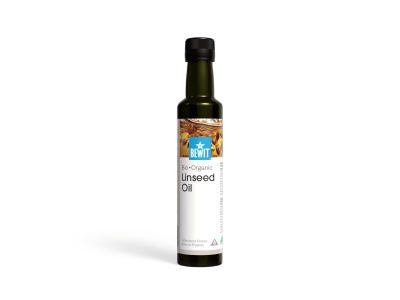
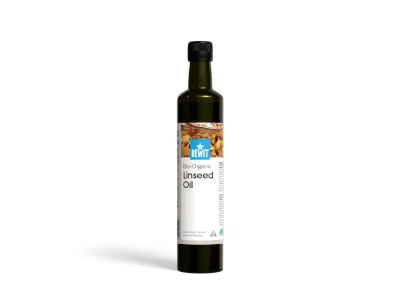
LINSEED OIL IN ORGANIC QUALITY
"The ‚oil of the third millennium‘ has a yellow-gold colour and a
slightly nutty taste with bitter undertones. You can work magic with it
exclusively in the cold kitchen. Made with love and care in our
production plant in Ostrava.
History
More than 7000 years ago
The benefits of linseed and its products have been known for more than
7000 years. The very Latin name „Linum usitatissimum“ speaks of the
versatility and usefulness of this oilseed from whose seeds linseed oil
is obtained.
The beneficial effects were written down by Hippocrates himself
The famous Hippocrates, who is considered the father of medicine, did not
give up on this fluid miracle. In his medical writings, the
Corpus Hippocraticum, he wrote down in detail all the beneficial effects of
linseed oil. The individual writings contain valuable information and
recommendations for both external and internal use.
Even the pomace, or waste product from the pressing of the oil, was not
wasted. Thanks to their high nutritional value they were added
to the feed for the cattle of the time.
Cultivation and origin
Linseed oil is one of the rarest oils
Linseed is a relatively well-known and widespread oilseed. In the
wild, it is not to be missed. It grows to a height of almost one metre
and produces beautiful sky-blue flowers with a slight white tinge.
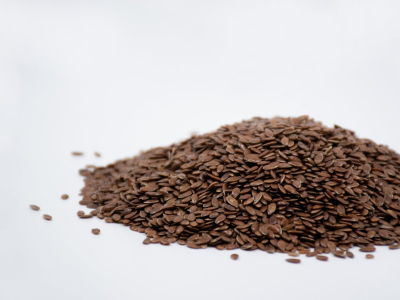
The fruit of the linseed plant is a crumbling or closed capsule. Inside the
capsule are dark brown, oval-shaped grains from which the resulting oil is
pressed. Up to 7 kg of linseed are used per litre of quality
oil. This is why linseed oil is one of the rarest oils.
The seeds from which we press linseed oil come
from India.
Composition and properties
Linseed oil is considered one of the richest sources of essential fatty
acids. It has earned the name "oil of the third millennium ".
The uniqueness of this yellow-golden oil lies primarily in its high
content of the omega-3 fatty acid α-linolenic acid, which is
presentin up to 55%. The omega-6 fatty acid linoleic acid
makes up 13%. These acids form an indispensable part of a balanced diet and
contribute to achieving the ideal ratio of essential fatty acids
intake.
Nutrient-packed food
Essential fatty acids cannot be created by the body on its own, so they must
be consumed in the diet. Together with the other biologically active substances
contained in the oil, this RAW cold-pressed oil is literally a
nutrient-packed food.
Read carefully
While the high content of essential fatty acids is behind
the exceptional nutritional properties of linseed oil, their significant
disadvantage is that they are easily perishable. Therefore,
store it in a fridge immediately upon receipt and consume
within 3 months. Keep the linseed oil in its original dark
glass bottle for the entire storage period.
The spoilage processes accompanying the development of a highly
bitter taste are a natural characteristic of
linseed oil. However, by proper storage, the onset of these
processes can be delayed as much as possible.
Usage
In vegetable and legume salads, on crusty bread, in yoghurt and
cottage cheese
Freshly pressed linseed oil is typical for its slightly nutty flavour
with lingering bitter undertones. It is used exclusively in cold
cooking because its beneficial substances are sensitive to high
temperatures. It is excellent in combination with cold vegetable and legume
salads. We recommend it to sprinkle on crusty bread or other favourite pastries.
You can also stir a tablespoon of linseed oil into yoghurt and cottage
cheese.
Czech botanical name: Flax
English name: Linseed oil
Latin name: Linum Usitatissimum Seed Oil
Made in: Czech Republic
Sources
[1] MEMON, M Ashraf et al., 2016. Trachyspermum Ammi and Linum Usitatissimum
are medicinal herbs used as hypolipidemic agents which protect against coronary
artery disease. Medeniyet Medical Journal. 31(4), 282–286.
[2] GUI, Bo et al., 2012. Identification and Quantification of
Cyclolinopeptides in Five Flaxseed Cultivars. Journal of Agricultural and Food
Chemistry. 60(35), 8571–8579.
[3] DE SOUZA FRANCO, Eryvelton et al., 2012. Effect of a Semisolid
Formulation of Linum usitatissimum L. (Linseed) Oil on the Repair of Skin
Wounds. Research Article. 1–7.
[4] OMAH, B. Dave, Edward O. KENASCHUK, and Giuseppe MAZZA,
1997. Tocopherols in Flaxseed. Journal of Agricultural and Food Chemistry. 45,
2076–2080.




 Български
 Čeština
 Deutsch
 Eesti
 Español
 Français
 Hrvatski
 Italiano
 Latviešu
 Lietuvių
 Magyar
 Nederlands
 Norsk
 Polski
 Português
 Română
 Русский
 Slovenčina
 Slovenščina









 SK (

 HU (

 CS (



 SI (



