





 Български
 Čeština
 Deutsch
 Eesti
Eesti
 Español
 Français
 Hrvatski
 Italiano
 Latviešu
 Lietuvių
 Magyar
 Nederlands
 Norsk
Norsk
 Polski
 Português
 Română
 Русский
 Slovenčina
 Slovenščina

Do you ever feel exhausted for no apparent reason, emotionally unstable, or lacking inner peace and the courage to make an important decision? Do you wonder why some days your thoughts flow with ease, and other days you feel overwhelmed and uninspired? Our organism perceives the world not only through the physical body. Alongside muscles, organs, and nerves, traditional teachings state that subtle life energy flows within us, passing through specific centres, known as chakras.
In this article, we will look at exactly what chakras are, where they are located in the body, and how to recognise a blocked chakra. You will learn how to support individual centres with conscious breathing, meditation, and aromatherapy, and how essential oil blends from the BEWIT Chakra range can help you with this.
What are chakras and how do they work?
The word chakra comes from the ancient Indian language Sanskrit and translates as "wheel". According to traditional Hindu and Buddhist teachings, chakras are energy centres that receive, transform, and distribute life energy, often referred to as prana, throughout the body.
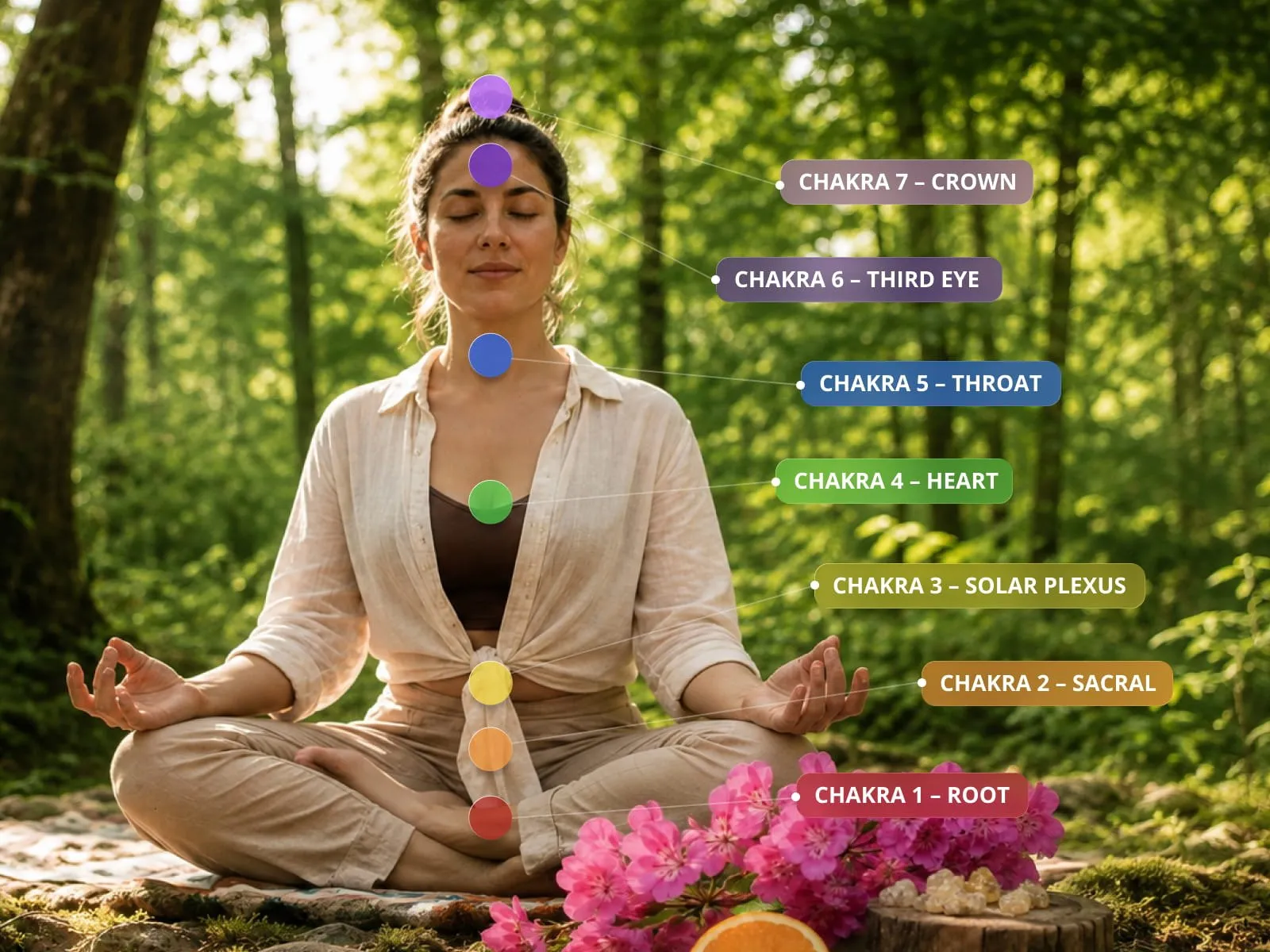
You can imagine them as subtle vortices located along the spine from its base to the crown of the head. Although they are not visible to the naked eye, traditional teachings connect them with our physical body. Each of the seven main chakras is usually assigned to one of the endocrine glands and a corresponding group of organs.
When energy flows freely and in balance, we feel internally strong, grounded, and full of vitality. However, if we experience long-term stress, unexpressed emotions, or a lack of rest, the energy in some centres can become blocked or unbalanced. According to traditional teachings, this then manifests as fatigue, inner tension, or discomfort in the corresponding part of the body.
You can support your chakras with conscious breathing, dietary adjustments, exercise, meditation, and a regular ritual with essential oils.
How to recognise a blocked chakra?
A "blocked chakra" is spoken of when energy does not flow freely through a given centre and its theme becomes unbalanced. The manifestation can be different for each chakra, ranging from insecurity and a lack of stability to emotional fluctuations and loss of motivation, to difficulty in self-expression or an overwhelmed mind.
Therefore, a key indicator can be the area of life in which you have long felt uncomfortable. The root chakra is associated with safety, the sacral with emotions and creativity, the solar plexus with self-confidence, the heart with relationships, the throat with communication, the third eye with intuition, and the crown chakra with consciousness and spiritual transcendence.
Discover the 7 main chakras
Each centre has its own colour, area of life, and part of the body to which it traditionally relates.
1. Root Chakra Muladhara: safety and solid ground beneath your feet
The root chakra is located at the base of the spine and represents the foundation of the entire energy system. Its colour is red and its element is earth. It is traditionally associated primarily with a sense of safety, stability, trust in life, and the ability to stand firmly on the ground.
Its location is also reflected in bodily connections. Muladhara traditionally relates primarily to the lower spine, pelvis, legs, and feet, i.e., the areas that support us and ensure contact with the ground. In some interpretations, the kidneys, large intestine, and adrenal glands are also associated with the first chakra.
When the Muladhara is in balance, we feel grounded and have a sense of being able to rely on ourselves. We can accept changes without every uncertainty immediately throwing us off balance.
Conversely, if the energy of the first chakra is weakened, traditional understanding suggests that uncertainty, fear, a feeling of instability or a lack of support may appear. With excessive activity, the opposite extreme may manifest, such as clinging to certainties, unwillingness to change, or an exaggerated need to control everything.
You can support the first chakra primarily by doing things that bring you back into your body and into the present moment. Spending time in nature, walking, working with the earth, slow movement, or grounding meditation can be simple ways to tune into its theme.
Aromatherapeutic support for the first chakra can be found in the essential oil blend BEWIT Chakra 1. Its sweet, floral-woody scent with warm earthy notes combines, for example, Atlas cedar, Deodara cedar, white spruce, myrrh, frankincense, palo santo, and vetiver.
TIP: During meditation, imagine strong roots growing from the lower part of your body deep into the earth. Take several slow breaths and silently repeat a simple affirmation: “I am safe.”

2. Sacral Chakra Svadhisthana: emotions, creativity, and joy
The second chakra is located in the lower abdomen and pelvis area. It is associated with the colour orange and the element of water, which aptly captures its main theme: the ability to flow, accept change, and experience emotions without unnecessary suppression.
On a physical level, Svadhisthana is traditionally related primarily to the pelvic area, lower abdomen, bladder, and reproductive organs. In some contemporary systems, the gonads are also associated with it. The element of water is then symbolically reflected in its connection with bodily fluids.
Svadhisthana is traditionally associated with creativity, sensuality, joy, relationships, and the ability to experience pleasure. This is not just about intimate partnerships. It also includes the joy of movement, good food, music, creation, or anything that allows us to fully immerse ourselves in the present moment.
With a harmonious second chakra, we can accept our own emotions, be creative, and respond flexibly to changes. According to traditional teachings, imbalance can manifest as emotional fluctuations, loss of creativity, excessive control, or, conversely, a strong dependence on external experiences.
To support the second chakra, anything that moves the body and awakens the senses is suitable, such as dance, swimming, conscious movement, music, painting, or other creative activities.
To support the second chakra, use the blend BEWIT Chakra 2, which combines fresh citrus and floral notes with a delicate woody base. It contains, for example, neroli, sandalwood, ylang-ylang, geranium, clary sage, and citrus essences. It is therefore suitable for moments when you want to give more space to creativity, emotions, and natural flow.
TIP: Put on music you love and move for a few minutes without any plan or choreography. Don't worry about how the movement looks. Just feel the music, your breath, and your body.

3. Solar Plexus Chakra Manipura: personal power and courage to act
The third chakra, Manipura, is located in the solar plexus area above the navel. It is associated with yellow, the element of fire, and represents the centre of personal power, self-confidence, will, and the ability to take responsibility for one's own decisions.
Its bodily symbolism primarily focuses on the abdomen and digestion. Traditionally, it is linked to organs such as the stomach, liver, gallbladder, pancreas, and spleen. The motif of digestion and fire fits well with Manipura's symbolism as a centre that receives, processes, and transforms something into further energy.
The same principle extends to the psychological level. Its symbolism aptly captures the difference between wanting something and actually doing something about it.
If the third chakra is harmonious, according to traditional understanding, we are able to trust our own judgment, make decisions, and assert our needs without having to suppress others. We have enough inner fire to embark on things that are important to us.
When weakened, indecisiveness, passivity, self-doubt, or a lack of motivation may appear. Conversely, excessive activity can manifest as a need for control, stubbornness, impatience, or an exaggerated assertion of one's will.
You can support work with Manipura through more active movement, breathing focused on the abdominal area, spending time in the sun, or visualising warm yellow light or a calm flame.
BEWIT Chakra 3, with its fresh citrus scent complemented by subtle spicy and floral notes, fits into such a ritual. It contains grapefruit, lemon, ylang-ylang, and geranium, for example. You can use this blend when you need to strengthen your resolve before an important decision, a new challenge, sports, or starting a project you've been putting off for too long.
 3
3
4. Heart Chakra Anahata: love, compassion, and balance in relationships
Exactly in the middle of the seven-chakra system is the heart chakra, Anahata. It is located in the centre of the chest, its traditional colour is green, its element is air, and it is associated with love, compassion, empathy, gratitude, and the ability to create healthy relationships.
Traditionally, Anahata is primarily associated with the heart, lungs, and chest, and in some chakra systems, also with the thymus. It is therefore no coincidence that conscious breathing and opening the chest area are often used when working with the heart chakra.
The fourth chakra holds a special position in the entire system. It forms a symbolic bridge between the three lower chakras connected with the body and our functioning in the world, and the three upper chakras related to communication, intuition, and consciousness.
A harmonious Anahata is not just about the ability to give love to others. It is equally important to be able to receive it and not forget about oneself in the process.
If the heart chakra is weakened according to traditional understanding, closed-mindedness, distrust, difficulty accepting intimacy, or problems with forgiveness may appear. Conversely, excessive activity can manifest as a tendency towards self-sacrifice, excessive dependence on others, or a need for constant reassurance.
The theme of the fourth chakra is linked to conscious breathing, meditation focused on gratitude, gentle yoga, or a simple moment where you turn your attention to what is good in your life.
You can complement an aromatherapy ritual to support the fourth chakra with the BEWIT Chakra 4 blend. This delicate floral blend with woody and citrus notes contains rose, rosewood, sandalwood, and lavender, for example.
TIP: In the evening, try to recall three specific moments that brought you joy during the day. Gratitude doesn't have to be directed only at major life events. Sometimes, a good meal, a message from a loved one, or a few minutes in the sun are enough.
5. Throat Chakra Vishuddha: communication and the ability to express your truth
The Throat Chakra Vishuddha is located in the neck area and is traditionally associated with the colour blue and the element of space, also referred to as ether. It is the centre of communication, listening, authenticity, and the ability to translate what we feel inside into words.
Its traditional connection to the body corresponds to this. The fifth chakra primarily relates to the area of the neck, throat, mouth, jaw, and vocal apparatus. In some contemporary chakra systems, the thyroid gland is also associated with it.
However, its theme is not limited to public speaking. It manifests whenever we need to say what we think, ask for help, express disagreement, set a boundary, or name our own emotions.
A balanced fifth chakra, according to traditional understanding, allows for clear and respectful communication. However, the ability to truly listen to others is equally important.
When out of balance, it can be difficult to express one's own needs; one may be afraid to speak up or, conversely, feel a constant need to talk and not give space to others.
Therefore, the throat chakra is traditionally worked with through singing, mantras, loud reading, writing, breathing techniques, or conscious communication.
For this area, BEWIT Chakra 5 was created. This warm, resinous-woody composition with a slightly cooling touch contains, for example, bergamot, clary sage, geranium, and frankincense. It is suitable before an important conversation, presentation, writing, or whenever you first need to clarify for yourself what you truly want to communicate.

6. Third Eye Chakra Ajna: intuition and a clear mind
Between the eyebrows, according to the traditional chakra system, lies Ajna, or the Third Eye Chakra. Its colour is indigo and it is associated with intuition, insight, imagination, concentration, and the ability to see things in broader contexts. Unlike the first five chakras, Ajna is no longer associated with any of the five basic elements.
On a physical level, the sixth chakra traditionally relates primarily to the area of the forehead, eyes, and head. In modern chakra interpretations, the pituitary gland, one of the main endocrine glands, is also often associated with it.
The sixth chakra turns our attention from the external world inwards. Its theme is therefore closely linked to the ability to quiet the constant stream of thoughts and create space for one's own perception.
If Ajna is in balance, traditional teachings associate it with a clear mind, intuition, and the ability to concentrate. When out of balance, there may be mental overwhelm, distractibility, an inability to clarify things, or conversely, excessive confinement in one's own imagination.
For working with the sixth chakra, meditation, visualisation, conscious breathing, moments of silence, or journaling are particularly suitable.
BEWIT Chakra 6 has a herbaceous-woody, warm, and clean scent. The blend includes, for example, clary sage, rosemary, frankincense, sandalwood, palo santo, and immortelle. You can use it during meditation or when you need to reduce external stimuli, organise your thoughts, and turn your attention inwards.

7. Crown Chakra Sahasrara: Consciousness and Spiritual Transcendence
The last of the seven main centres is called Sahasrara, or the crown chakra. It is located at the crown or just above the crown of the head and is typically depicted in purple or white. Unlike the first five chakras, it is no longer associated with any of the five basic elements. It represents the subtlest level of the chakra system and is traditionally linked with consciousness, knowledge, inner wisdom, and the spiritual dimension of life.
Its theme is not solely spirituality in a religious sense. Sahasrara also symbolises the ability to step back from one's daily worries, view life from a greater distance, and perceive broader contexts. Instead of constantly thinking about what we still need to do, it shifts attention to questions of what is truly important to us and what meaning the things we dedicate our time and energy to hold.
Its connection to the physical body is the least concrete of all seven chakras. In contemporary chakra interpretations, it primarily relates to the head, brain, and nervous system, and the pineal gland is often associated with it as well.
According to traditional understanding, a harmonious Sahasrara manifests as a clear mind, inner peace, openness, and the ability to see one's life in a broader context. When unbalanced, one might experience a feeling of losing direction and inner disconnection, or, conversely, an extreme immersion in the spiritual world and detachment from practical life.
Therefore, the seventh chakra is primarily worked with through meditation, silence, mindfulness, contemplation, and conscious pausing. The goal is not to stop thinking, but to create enough space in the mind so that every moment doesn't have to be filled with another task, piece of information, or stimulus.
For these moments, you can use BEWIT Chakra 7. Its aroma combines cool herbal notes with a sweeter floral heart and a warm balsamic-woody base. It is suitable as an aromatherapy accompaniment for meditation, yoga, evening quiet time, or moments dedicated to one's inner self.
TIP: Try to set aside a few minutes each day for complete silence, without your phone, music, podcasts, or another task. Just observe your breath and the thoughts that come to you. The ability to simply "be" for a while perfectly encapsulates the theme of the crown chakra.

What to remember from the article?
According to traditional Eastern teachings, chakras are energy centres located along the body's axis from the base of the spine to the crown of the head. Each of the seven main chakras has its own symbolism and is traditionally associated with a specific area of life and the body – from stability, emotions, and personal power, through relationships and communication, to intuition and spiritual transcendence.
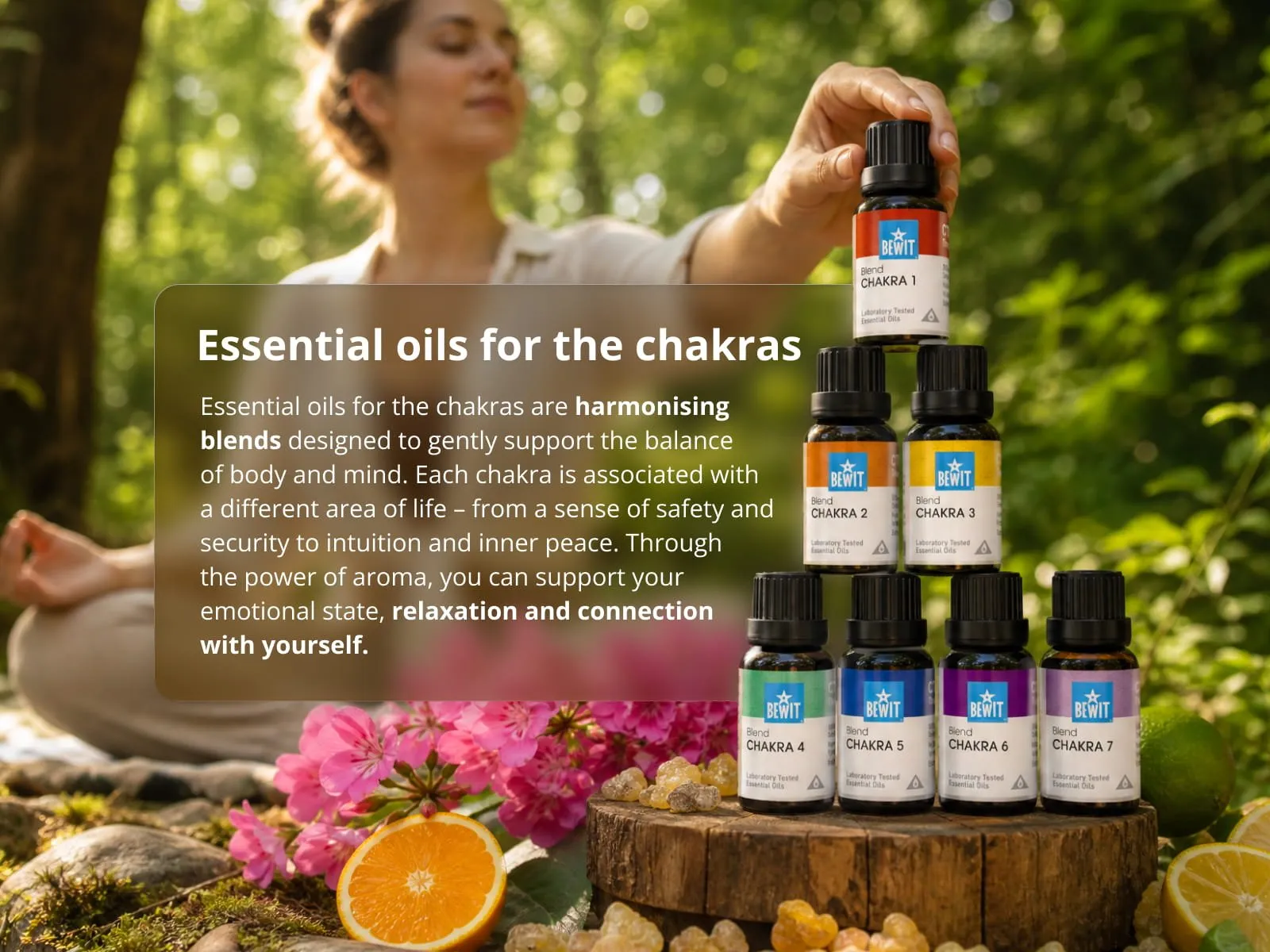
To harmonise your chakras, you can use conscious breathing, meditation, yoga, movement, visualisation, or aromatherapy. You don't have to work with all seven centres at once. Feel free to focus on the chakra whose theme resonates most with you right now. Aromatherapy support can be found in the BEWIT Chakra 1 to Chakra 7 essential blends, each created with the character of a specific energy centre in mind.
Frequently Asked Questions about Chakras
What are chakras?
Chakras are the body's energy centres, through which life energy, known as prana, is supposed to flow. The most well-known current system works with seven main chakras located from the base of the spine to the crown of the head.
What are the 7 main chakras?
From the bottom up, these are the Root Chakra Muladhara, Sacral Chakra Svadhisthana, Solar Plexus Chakra Manipura, Heart Chakra Anahata, Throat Chakra Vishuddha, Third Eye Chakra Ajna, and Crown Chakra Sahasrara. Each is traditionally associated with a different area of life, body part, colour, and symbolism.
How do I know if a chakra is out of balance?
According to the traditional chakra system, an imbalance can manifest primarily in the theme with which the given chakra is associated. For the first chakra, this could be, for example, a feeling of insecurity and lack of stability; for the second, a loss of creativity or emotional volatility; for the third, a lack of self-confidence and decisiveness. Other centres relate to relationships, communication, intuition, and spiritual transcendence. However, these manifestations should be understood within the context of the traditional energy system, not as a method for diagnosing health problems.
Which body parts are chakras associated with?
Each chakra in traditional and contemporary chakra systems relates to a specific area of the body. For example, the Root Chakra relates to the lower spine, pelvis, and legs; the Sacral Chakra to the lower abdomen and pelvic area; the Solar Plexus to the abdominal area; the Heart Chakra to the chest; the Throat Chakra to the throat and vocal apparatus; the Third Eye to the forehead and head area; and the Crown Chakra to the crown of the head. In some interpretations, specific organs and endocrine glands are also assigned to individual chakras.
How to harmonise chakras?
Among the most common ways of working with chakras are meditation, conscious breathing, yoga and other movement, visualisation, affirmations, or working with essences. You can choose individual techniques according to the specific chakra – for example, grounding activities and contact with nature benefit the root chakra, fluid movement and creation benefit the sacral chakra, while the sixth and seventh chakras are more associated with meditation and stillness.
How long does chakra harmonisation take?
There is no precise time after which a chakra can be considered "harmonised". Working with chakras is better understood as regular care and a journey of self-discovery rather than a one-off process. For example, you can set aside a few minutes each day for proper breathing, meditation, or another ritual focused on a theme you wish to address.
How to use BEWIT Chakra essential blends?
It depends on the specific blend. The essential oils from the BEWIT Chakra 1–7 range can be used for inhalation, meditation, massage, bathing, or to create a personal perfume, according to the recommended method of use. When applying concentrated essential oils to the skin, always follow the recommended dilution stated for the specific product.
Which BEWIT Chakra blend should I choose?
Follow the theme you wish to focus on right now. Chakra 1 is associated with stability and grounding, Chakra 2 with emotions and creativity, Chakra 3 with personal power and determination, Chakra 4 with love and relationships, Chakra 5 with communication, Chakra 6 with intuition and inner insight, and Chakra 7 with meditation, consciousness, and spiritual transcendence.


