



 Български
 Čeština
 Deutsch
 Eesti
Eesti
 Español
 Français
 Hrvatski
 Italiano
 Latviešu
 Lietuvių
 Magyar
 Nederlands
 Norsk
Norsk
 Polski
 Português
 Română
 Русский
 Slovenčina
 Slovenščina
For our ancestors, the night of 23rd to 24th June was one of the most magical of the entire year. It was called Midsummer's Eve, and it was believed that at this time, nature gave forth its best. Herbs gathered at this time were said to acquire unprecedented strength and abilities they didn't possess at other times. Among these herbs, St. John's Wort, popularly known as the Midsummer herb, always held one of the most honoured places.
St. John's Wort flowers precisely at the time of the summer solstice, and St. John's Day, 24th June, is traditionally considered the peak of its power. This is also where its English name, St. John's wort, comes from. For centuries, it was gathered precisely at this time, and oil was prepared from its fresh flowers, valued for skin care and tired muscles. In today's article, we will look at why herbalists gathered St. John's Wort at this time and how you can use it in your daily skin and body care today.

Midsummer's Eve and its traditions
Midsummer's Eve has its roots in pagan celebrations of the summer solstice, during which Celts paid homage to the Mother Goddess. Christianity built upon this tradition with the feast of John the Baptist, whose birth is celebrated on 24th June. It was believed that on this night, nature lent its greatest power to people, and its hidden treasures opened up to the earth.
An integral part of the celebration was fire. Bonfires burned on hills and elevated places as an earthly symbol of the sun, and their glow was meant to symbolically protect the entire surroundings from evil forces. People gathered around the fires, danced and sang, and brave souls jumped over them as a display of courage and a desire for robust health. Engaged girls threw wreaths over the flames, believing that if their beloved caught it, a shared future awaited them.
Herbs played an equally important role as fire. Nine different herbs were gathered, and they had to come from nine different places, with St. John's Wort being indispensable. Herbs collected on this night were attributed exceptional power, and each had its use. Tinctures and ointments were prepared from them, they were burned in fires, or used for divination. Unmarried girls placed them under their pillows to dream of their future husbands, brides sewed them into the groom's shirt as a promise of a happy marriage. For children, so-called Midsummer cradles, small baskets, were made from herbs, into which St. John would deliver sweets overnight.
Wreaths were not only used for throwing over fires. Girls also floated them on water. A wreath that floated freely downstream foretold an early wedding; if the wreath got stuck, it meant they would have to wait longer for marriage. According to legend, on this night, it was also possible to find golden ferns blooming only at midnight, whose spores showed the way to hidden treasures.
Why is St. John's Wort gathered on St. John's Day?
The tradition of gathering St. John's Wort during the summer solstice is not just folk superstition, but also has a very practical basis. St. John's Wort reaches its highest concentration of active substances during its flowering period, which is precisely around St. John's Day.
The Latin species name Hypericum is probably derived from the Greek words hyper (above) and eikon (image) and refers to the old tradition of hanging bunches of St. John's Wort as protection for the entire coming year. It was also hung on the doors of homes and stables as protection against illness and evil forces, and after drying, it served as incense.
Our ancestors gave St. John's Wort a great many names. Thanks to the red pigment in its flowers, you can find it under names like bloodwort, blood herb, or St. John's blood, but also wizard's herb, perforate, or Midsummer herb. This red pigment is called hypericin and is one of the main active ingredients of St. John's Wort. St. John's Wort has also been used since ancient times for skin care, for treating or for stiff muscles.

How to incorporate St. John's Wort into your daily routine
St. John's Wort is now available in forms that allow for convenient daily use while retaining all that our ancestors valued in it.
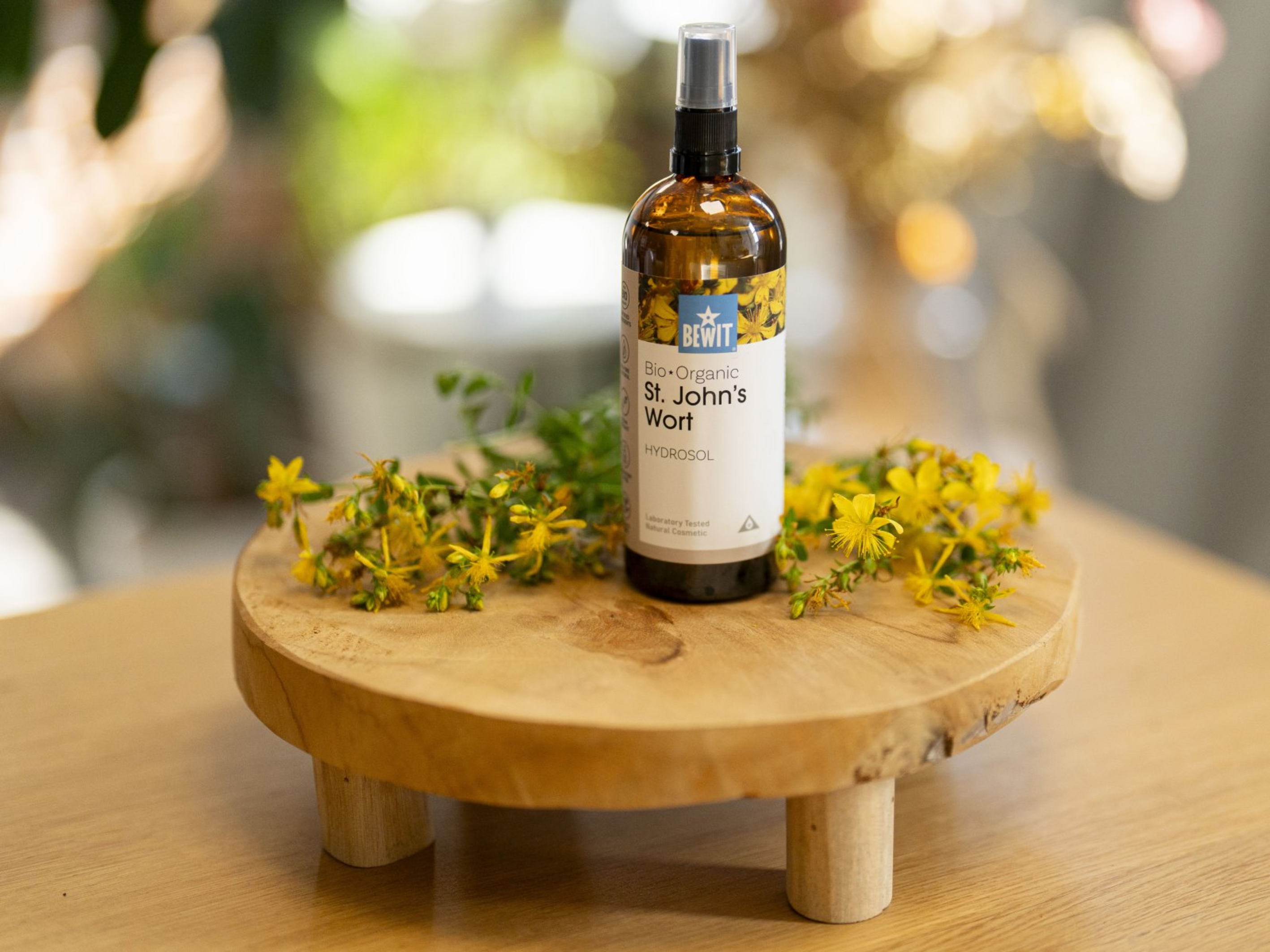
Organic St. John's Wort Hydrolat
Does constant stress show on your skin, making it look older, exhausted, or irritated? BEWIT St. John's Wort Hydrolat will soothe and support your skin, restoring its youthful glow. It creates a protective shield against harmful influences, reduces signs of fatigue, and smooths fine lines. Your skin will feel smoother to the touch and look fresher, and thanks to the calming effects of St. John's Wort, it will also bring relief to an overworked mind.
The hydrolat is gentle on all skin types, including sensitive, dry, and problematic skin. In skin care, you use it as a toner after cleansing: first, remove make-up and cleanse your skin, then apply the hydrolat, and massage BEWIT Vegan Collagen Serum into the damp skin, followed by a face cream. It also works as a base before applying St. John's Wort oil, as the oil absorbs better into skin prepared in this way. For hair care, massage the hydrolat into washed scalp, or apply it as a leave-in conditioner to damp or dry ends. Use the hydrolat anytime during the day to refresh and hydrate your hair.
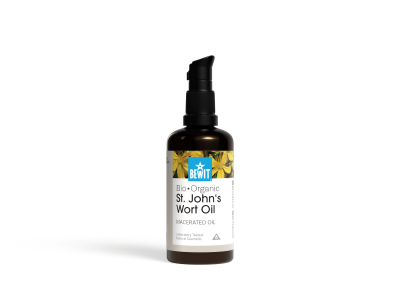
Organic St. John's Wort Oil, Oil Macerate
Has your skin or muscles taken a beating? BEWIT Organic St. John's Wort Oil is created by slowly macerating fresh, hand-picked St. John's Wort from the Beskydy mountains in sunflower oil, during which the active ingredients are naturally released into the base. The result is a soothing and healing product with a characteristic amber to reddish colour, which comes precisely from the hypericin contained in the flowers. This natural colour difference is the result of specific conditions during harvesting and the maceration process. Regardless of the colour intensity, St. John's Wort oil retains all its active ingredients and therapeutic properties.
The oil soothes and nourishes the skin after sun exposure, helps regenerate minor skin imperfections, and relieves tension in tired and overworked muscles. It is enriched with vitamin E with a natural anti-ageing effect and is suitable for all skin types, including very sensitive skin.
Shake the oil before applying and apply to clean, damp skin. Ideally, first moisten the skin with a hydrolat; the oil will then absorb beautifully into the prepared skin and better absorb the active ingredients. Due to photosensitivity, it should always be applied in the evening or after sun exposure and should not be used before sun exposure.
What to remember from the article?
St. John's Wort has been gathered for centuries during the summer solstice, when it reaches its highest concentration of active substances, which is why it is called the Midsummer herb. This custom is not just folk tradition, but also has a very practical basis, confirmed by modern herbalism.
Today, St. John's Wort can be found in many forms, from teas and tinctures to cosmetic products. In skin and body care, two forms particularly stand out: hydrolat as a gentle daily toner for skin and hair, and oil macerate as a soothing treatment for skin after sun exposure and tired muscles. Both forms can be beautifully combined, and their effects mutually enhance each other.
Frequently Asked Questions about St. John's Wort
Why is St. John's Wort called the Midsummer herb?
Because it was traditionally gathered around St. John's Day, 24th June, when it reaches its peak flowering and also its highest concentration of active substances. This feast is closely associated with the summer solstice and has been considered for centuries a special time for gathering medicinal plants. St. John's Wort was always the most significant of them.
What is the difference between St. John's Wort hydrolat and oil?
Hydrolat is a gentle floral water suitable as a facial toner or as a leave-in conditioner for hair. The oil macerate is ideal for skin and muscles, evening care, and as an after-sun oil. Both forms can be combined and mutually enhance their effects.
Can St. John's Wort hydrolat or oil cause sun sensitivity?
The oil macerate should not be applied before sun exposure, always after it, ideally in the evening. After application, it is advisable to stay in the shade for at least 24 hours. Hydrolat, in very high doses, can increase sensitivity to sunlight, but with standard use as a facial toner, it is safe.
Why is St. John's Wort oil red?
The characteristic amber to reddish colour of St. John's Wort oil is due to hypericin, a natural pigment contained in the flowers of St. John's Wort.
Can St. John's Wort hydrolat and oil be combined?
Yes, both forms complement each other. Apply the hydrolat as the first step to clean skin to hydrate and prepare the skin for subsequent care. The St. John's Wort oil will then absorb better into the moistened skin.
Related products