History
Green barley is considered one of the oldest green cultivated plants. Its
effects were discovered 7,000 years ago in ancient China. Based on its
beneficial effects, the use of this plant spread throughout Asia and
subsequently to the Middle East. In the following years, awareness of barley
spread to Europe and other parts of the world. It was also very popular in
ancient Rome, where it was one of the special foods given to gladiators to
improve their performance.
Origin and Cultivation
This green plant originates from India, where it has been cultivated since
time immemorial. It is a very fast-growing plant. Just ten days after planting
the seeds, young green shoots emerge from the sprouts. The shoots are harvested
on the twentieth day after germination, i.e., in the early stage of the
plant's life. Plants harvested at this stage of growth represent a significant
source of nutrients and biologically active substances.
Production Process
Unlike dried extracts, which are made from dried extracted juice, the
extraction process is completely omitted in the production of our product. Our
product is therefore manufactured using a different method, which includes the
following procedures. The harvested young barley shoots are gently dried and
then ground into the resulting powder. It is gently processed to retain as many
of its unique properties and maximum nutritional value as possible.
YOUNG BARLEY POWDER vs. YOUNG BARLEY JUICE POWDER
This product represents the classic form of young barley made from
whole dried young barley shoots. It thus retains its natural
fibre, full plant structure, and a comprehensive spectrum of
nutrients in their original form. It is a suitable choice for those who
prefer a holistic plant form with a natural content of insoluble
components. For users looking for a nutritionally more intense
and concentrated variant, young barley juice
powder is also available. This is created by pressing fresh shoots and then
gently drying the obtained juice. This method primarily captures active enzymes,
vitamins, and other heat-sensitive phytonutrients, giving this variant a
fine, rapidly soluble consistency and a higher concentration of selected
biologically active substances.
Composition and Properties
Based on the harvest time and subsequent gentle processing of the shoots,
this is a nutritionally significant product. Young barley powder is a rich
source of minerals, vitamins, amino acids, and other phytonutrients in its pure
natural form. However, some of the contained substances are sensitive to higher
temperatures, so barley should be consumed cold. Do not mix with hot drinks, as
this could damage active enzymes.
Since young barley shoots are also a natural source of water-insoluble
substances, the powder is only partially soluble in water. Insoluble particles
may form sediment at the bottom of the glass, which is a completely natural
phenomenon for young barley powder. If sediment forms, we recommend stirring the
contents of the glass again and drinking the entire contents. Young barley
powder is an ideal ingredient for morning smoothies, cooled porridges, or
yoghurts, where, thanks to other components, the small particles of this powder
are better dispersed.
Recommended Dosage
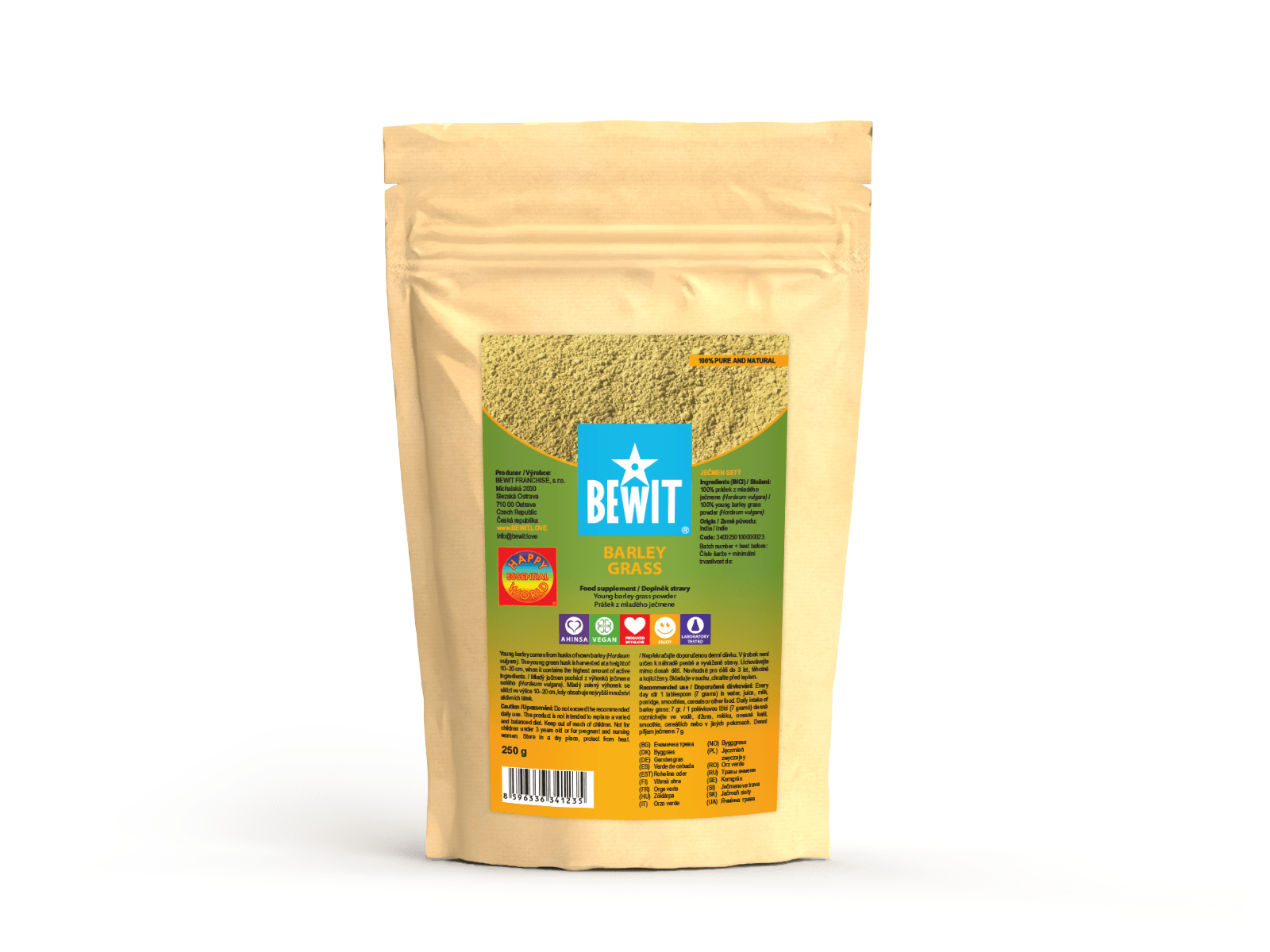
Mix 1 tablespoon (7 grams) daily in water, juice, milk, oatmeal, smoothies,
cereals, or other dishes. Daily intake of barley: 7 g.
Warning
- Do not exceed the recommended daily dose.
- The product is not intended as a substitute for a varied and
balanced diet.
- Keep out of reach of children.
- Not suitable for children under 3 years of age, pregnant, or
breastfeeding women.
- Store in a dry place, protect from heat.
Packaging: 250 g
Country of Origin: India
Sources
[1] VENUGOPAL, Shonima and Uma M. IYER, 2010. MANAGEMENT OF DIABETIC
DYSLIPIDEMIA WITH SUBATMOSPHERIC DEHYDRATED BARLEY GRASS POWDER. International
Journal of Green Pharmacy. 4(4), 1–6.
[2] ZENG, Yawen et al., 2018. Preventive and Therapeutic Role of Functional
Ingredients of Barley Grass for Chronic Diseases in Human Beings.
Hindawi-Oxidative Medicine and Cellular Longevity. 1–15.
[3] KOGA, Ryota et al., 2013. The effect of photo-irradiation on the growth
and ingredient composition of young green barley (Hordeum vulgare). Agricultural
Sciences. 4(4), 185–194.
[4] ASTOLFI, Stefania et al., 2010. Supply of sulphur to S-deficient young
barley seedlings restores their capability to cope with iron shortage. Journal
of Experimental Botany. 61(3), 799–806.
[5] BENEDET, JOHN A., HISAO UMEDA and TAKAYUKI SHIBAMOTO, 2007. Antioxidant
Activity of Flavonoids Isolated from Young Green Barley Leaves toward Biological
Lipid Samples. Journal of Agricultural and Food Chemistry. 55, 5499–5504.





 Български
 Čeština
 Deutsch
 Eesti
Eesti
 Español
 Français
 Hrvatski
 Italiano
 Latviešu
 Lietuvių
 Magyar
 Nederlands
 Norsk
Norsk
 Polski
 Português
 Română
 Русский
 Slovenčina
 Slovenščina














 CS (
CS (
