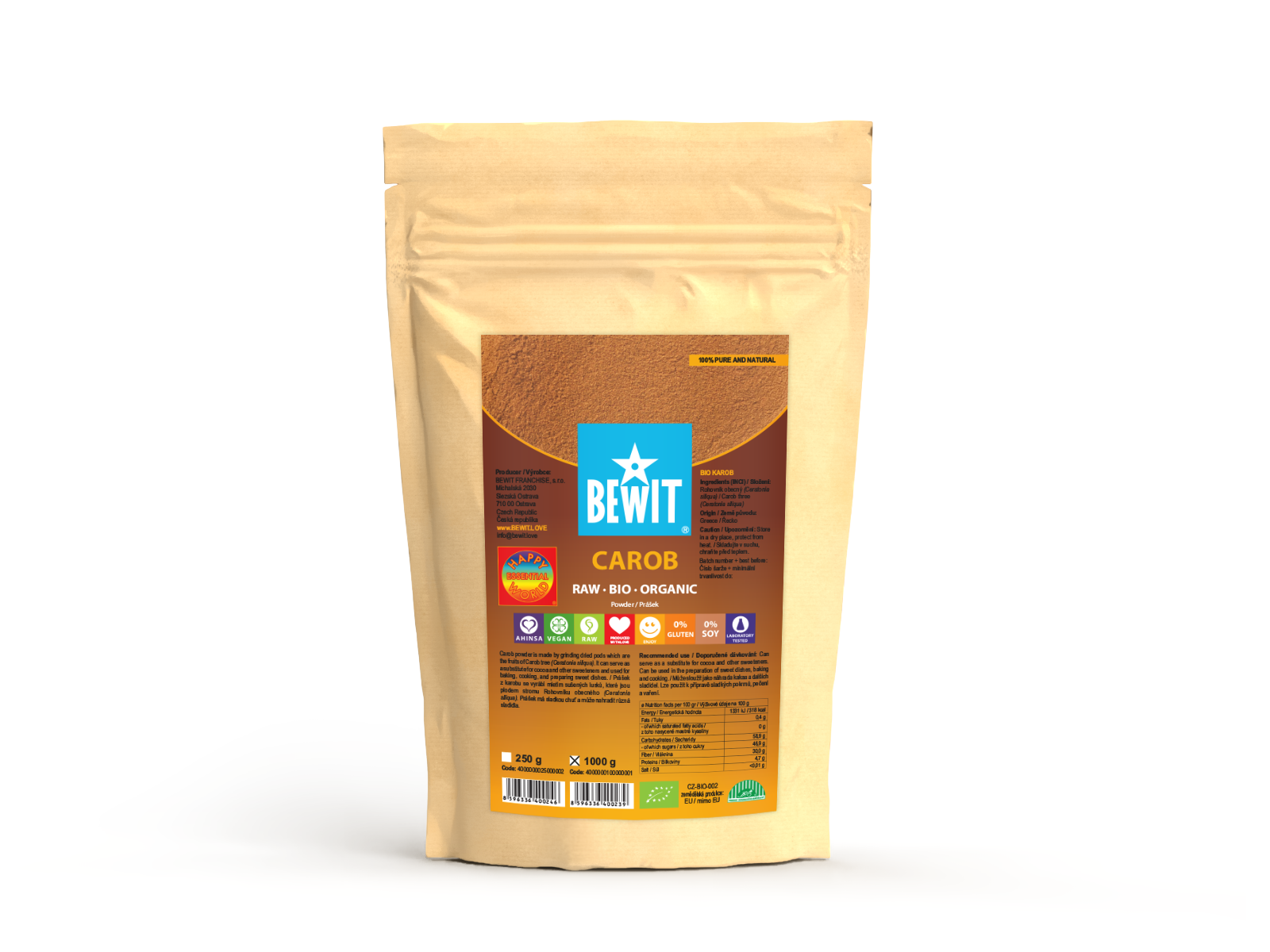
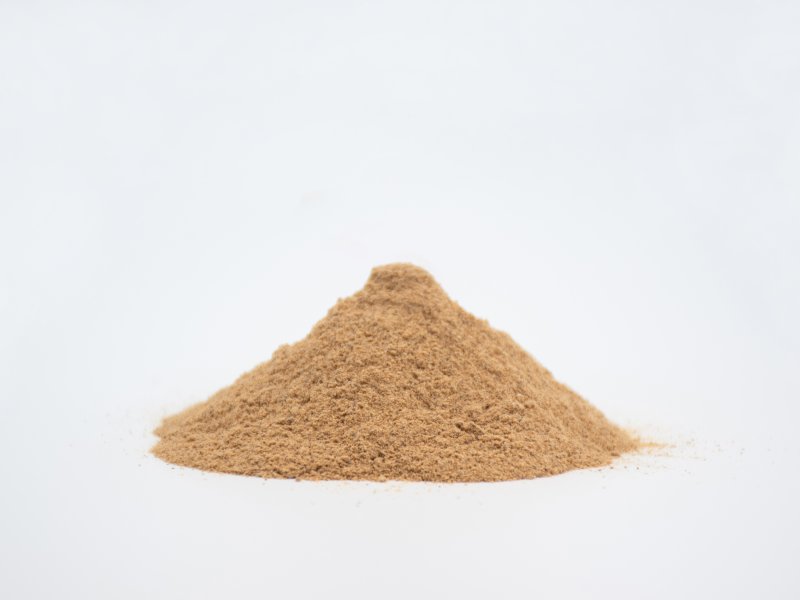
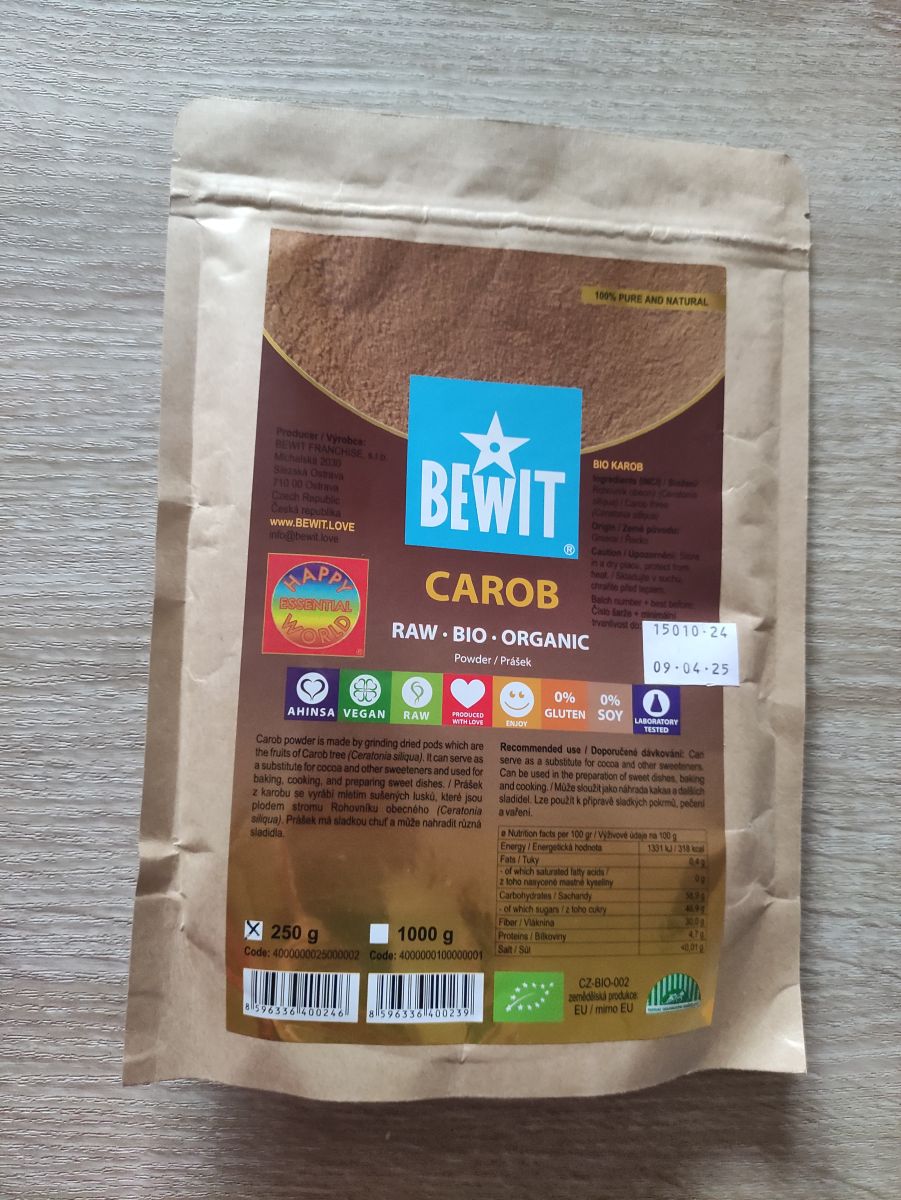
BIO RAW carob powder
BIO, RAW carob powder has a mild and delicious sweet taste.
It can be used as a substitute for refined sugars and other sweeteners. Besides,
it is a natural source of high fibre, which establishes a
feeling of satiety. Carob is also a source of vitamins, minerals and
other beneficial substances for the body.
History
Carob powder or locust bean
Carob is an ancient cultivated plant whose origins are traced to the
Mediterranean and Arabian Peninsula regions. Even then, its
fruits were a common part of the diet. Due to its popularity and use, the carob
tree has been spread throughout the Mediterranean, the coast of North Africa and
subsequently to other areas characterised by similar climates. Carob powder is
obtained from the ripe fruits of this evergreen tree. According
to one legend, the fruits of the carob tree were a favourite delicacy of
Saint John the Baptist, who ate them along with other dry foods on his
journey through the desert. Depending on this reputation, carob powder has
earned the name carob bread, under which it is often referred to.
Origin and cultivation
Harvest at full maturity
The peculiarity of the carob tree is that it flowers mainly in autumn. Due to
its climatic conditions, India is an ideal region for hornbeam
cultivation. Mainly depending on the warm climate and low rainfall. The
fruits of the carob tree are pods that are harvested at full maturity.
Very gentle production process
Immediately after harvesting, the carob pods are stripped of their inner
parts and kernels. The remaining packaging pulp is then processed into the final
powder in a very gentle process where no stage
exceeds 42°C.
Our carob powder guarantees premium RAW
quality.
Ingredients and product properties
Natural source of high fibre
BIO, RAW carob powder has a distinct sweet taste. It can be used as a
substitute for refined sugars and other sweeteners. Carob is also a rich
natural source of fibre, which promotes a lasting feeling of
fullness. Adequate fibre intake has a particular effect on
proper bowel function. Also, carob is a source of vitamins,
minerals and other substances beneficial to the body. Carob powder is
distinguished by its naturally sweet taste, thanks to the
naturally occurring carbohydrates. The fat content is lower compared to
cocoa.
Directions
Carob powder has naturally pleasant and sweet taste. Due to its typical
aroma, it also serves as a cocoa substitute.
To sum up
- Cocoa substitute
- Rich source of fibre
- Protein source
- Low salt content
- Super food
Country of origin
Greece
Sources:
KUMAZAWA, Shigenori et al., 2002. Antioxidant Activity of Polyphenols in
Carob Pods. Journal of Agricultural and Food Chemistry. 50, 373–377.
STAVROU, J., Ioannis, Atalanti CHRISTOU, and Constantina P.
KAPNISSI-CHRISTODOULOU, 2018. Polyphenols in carobs: A review on their
composition, antioxidant capacity and cytotoxic effects, and health
impact. Food Chemistry. 15, 355–374.
YDJEDD, Siham et al., 2017. Effect of in Vitro Gastrointestinal Digestion on
Encapsulated and Nonencapsulated Phenolic Compounds of Carob (Ceratonia siliqua
L.) Pulp Extracts and Their Antioxidant Capacity. Journal of Agricultural and
Food Chemistry. 65(4), 827–835.
JOSÉ CORREIA, Pedro et al., 2018. Biologically active compounds available
in Ceratonia siliqua L. grown in contrasting soils under Mediterranean
climate. Scientia Horticulturae. 228–234.
CANTALEJO, M. J., 1997. Effects of Roasting Temperature on the Aroma
Components of Carob (Ceratonia siliqua L.). Journal of Agricultural Food and
Chemistry. 45(4), 1345–1350.
LOULLIS, Andreas a Eftychia PINAKOULAKI, 2018. Carob as cocoa substitute: a
review on composition, health benefits and food applications. European Food
Research and Technology. 959–977.





 Čeština
 Français
 Български
 Nederlands
 Norsk
Norsk
 Italiano
 Română
 Slovenščina
 Slovenčina
 Deutsch
 Polski
 Hrvatski
 Español
 Magyar
 Pусский

















 SK (
SK (
 RO (
RO (
 CS (
CS (


 PL (
PL (


 HU (
HU (