History
It all started in far away China
The discoverers of this lush green plant are undoubtedly the Chinese. The
then Emperor Chen Nung recorded the information about the incredible
effects of cannabis in the first Chinese pharmacopoeia, which sparked
an avalanche of interest not only among Chinese physicians. As it happens, the
migration of nomadic peoples and proven experience spread the knowledge
of this sacred plant all over the world.
The plant has also become popular for its rapid growth and indiscriminate
use. The tasty and highly nutritious hemp seeds were added to
all kinds of dishes. With the advent of the first presses, the seeds were
pressed into valuable and versatile oil. The rich green leaves
were used to make healing herbal salves and poultices. The
remaining parts were used to make hemp fibre, a highly durable material for
making ropes and nets.
Interest in hemp oil is steadily increasing, not only among enthusiastic
consumers but also among manufacturers of purely natural-based dietary
supplements.
Cultivation and origin
Hemp is a low environmental impact plant**
The cannabis plant is particularly famous for its very fast growth and
relatively high resistance, for which no pesticides or herbicides are needed.
This makes it a low environmental impact crop. As early as 120 days after
planting, the hemp is harvested and the oval seeds are then gently pressed into
the resulting hemp oil.
Our hemp oil from China is ORGANIC certified.
Composition and properties
One of the best sources of polyunsaturated fatty acids
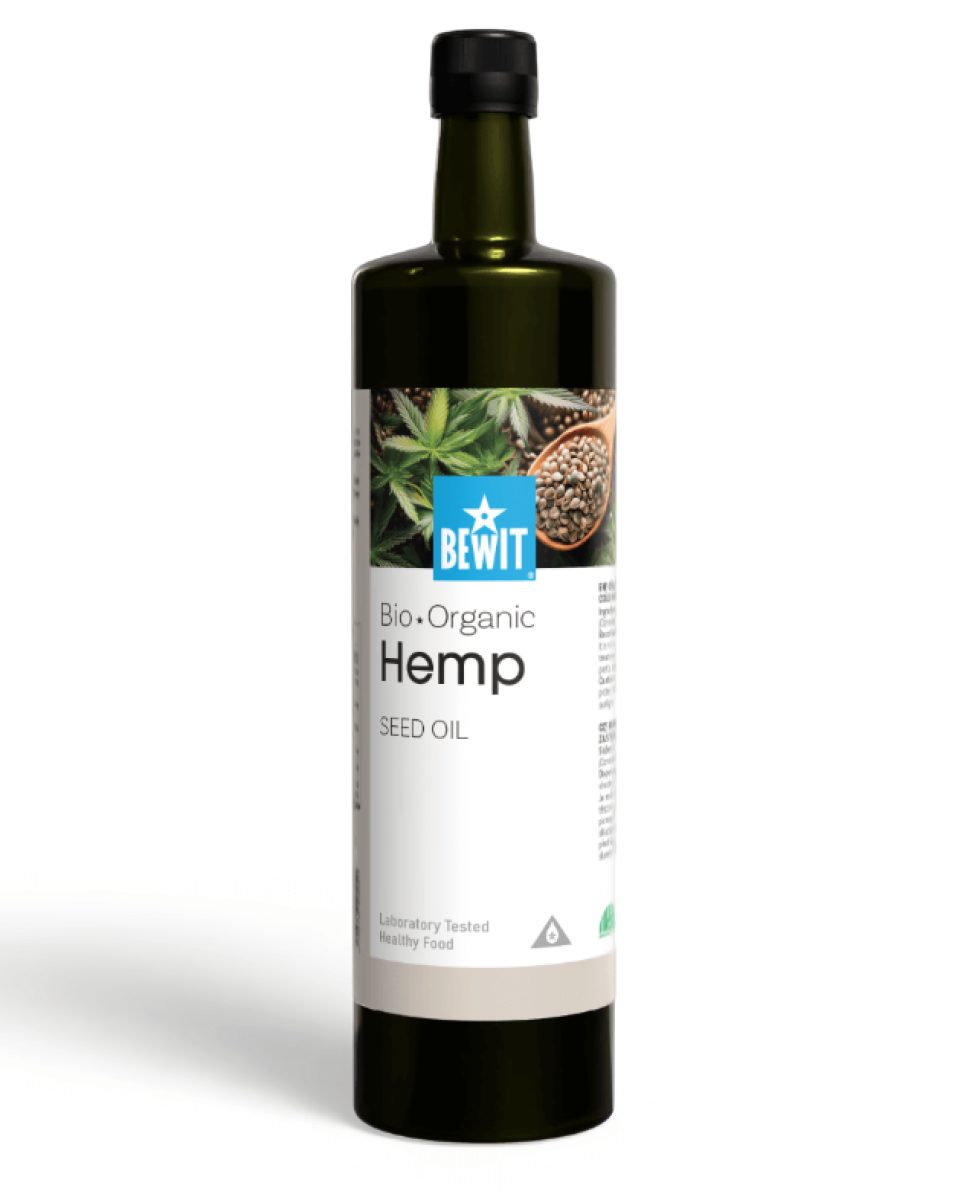
Hemp oil is characterized by its distinctive herbal taste and
aroma. Its colour is light to dark green, thanks to the chlorophyll
that is transferred to the resulting oil during the pressing of the seeds.
Hemp oil is also an important source of fat-soluble vitamins,
minerals, natural dyes and other phytonutrients, which are responsible
for its exceptional properties.
In addition, hemp oil belongs to the group of vegetable oils with an
ideal ratio of essential and polyunsaturated fatty acids (the
ratio corresponds to the traditional Japanese and Mediterranean diet). The
polyunsaturated fatty acid content is as high as 80%, making hemp oil
one of the best sources of polyunsaturated fatty acids
ever.
Use
Herbal flavour and aroma for cold food preparation**
It is used especially in cold food preparation because its
beneficial substances are sensitive to higher temperatures. It is used
especially in cold food preparation because its beneficial
substances are sensitive to higher temperatures. It is excellent in
combination with fresh vegetables. It can also be used to flavour
various spreads and cold dishes, adding a fresh colour and enhancing the
flavours contained.
Sources
S. BORHADE, Shobha, 2013. Chemical Composition and Characterization of Hemp
(Cannabis sativa) Seed oil and essential fatty acids by HPLC Method. Scholars
Research Library ### . 5(1), 5–8 [cited 2020–11–11]. Available from: www.scholarsresearchlibrary.com
FARINON, B. et al.2012. The Seed of Industrial Hemp (Cannabis sativa L.):
Nutritional Quality and Potential Functionality for Human Health and Nutrition.
Nutrients. (12), 1935–1994.
BONINIA, Sara Anna et al.2018: Cannabis sativa: A comprehensive
ethnopharmacological review of a medicinal plant with a long history. Journal
of Ethnopharmacology. 5(227), 300–315.
LEONARD, William et al., 2020. Hempseed in food industry: Nutritional value,
health benefits, and industrial applications. COMPREHENSIVE REVIEWS IN FOOD
SCIENCE AND FOOD SAFETY. 19(1), 282–308.
CROCQ, Marc-Antoine, 2020. History of cannabis and the endocannabinoid
system. Dialogues Clin Neuroscience. 22(3), 223–228.





 Български
 Čeština
 Deutsch
 Eesti
Eesti
 Español
 Français
 Hrvatski
 Italiano
 Latviešu
 Lietuvių
 Magyar
 Nederlands
 Norsk
Norsk
 Polski
 Português
 Română
 Русский
 Slovenčina
 Slovenščina







 CS (
CS ( RO (
RO ( HU (
HU ( PL (
PL (



 SK (
SK (